

 Facebook
 X
X
 Pinterest
 Copy Link

What Does a Balanced Market Actually Look Like?
If you have been following the real estate market lately, you have probably heard some version of this: “The market is becoming more balanced.”
I have said it myself.
But what does a balanced market actually look like?
For the last several years, most of us have become accustomed to thinking about the market in extremes. Either sellers have all the power, homes sell immediately with multiple offers, or houses are taking 6 months to sell and buyers have all the power to get a house for half what it was listed for after the seller has made all the repairs the Buyer has asked for.
There is a whole lot of room in between those two scenarios.
That in-between is where we are starting to find ourselves.
First, What Is a Balanced Market?
One of the ways we measure the balance between buyers and sellers is through months of inventory. Basically, if no new homes came on the market, how long would it take to sell the homes currently available at the present pace of sales?
Traditionally, somewhere around four to six months of inventory is considered a balanced market. Less inventory tends to favor sellers, while substantially more inventory tends to favor buyers.
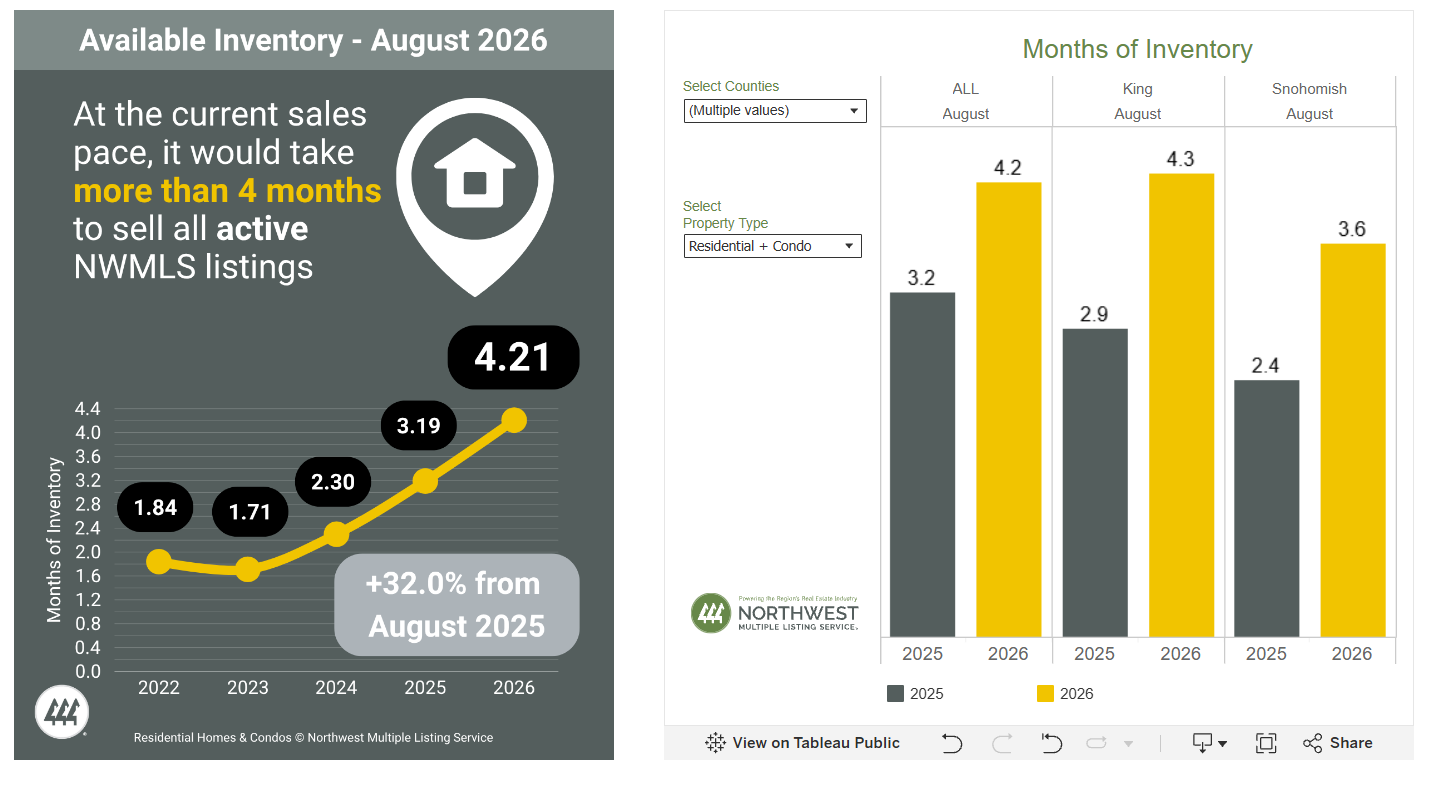
According to the latest Northwest Multiple Listing Service data, the overall NWMLS market reached 4.21 months of inventory in August, compared with 3.19 months a year ago.
Locally, King County reached 4.3 months of inventory, up from 2.9 months in August 2025. Snohomish County is at 3.64 months.
So are we in a balanced market?
In some places, we are getting pretty close. But I think the better description is that we are in a much more balanced market than we have been in a very long time.
And there is a difference.
Buyers Have More Choices
This is probably the biggest change.
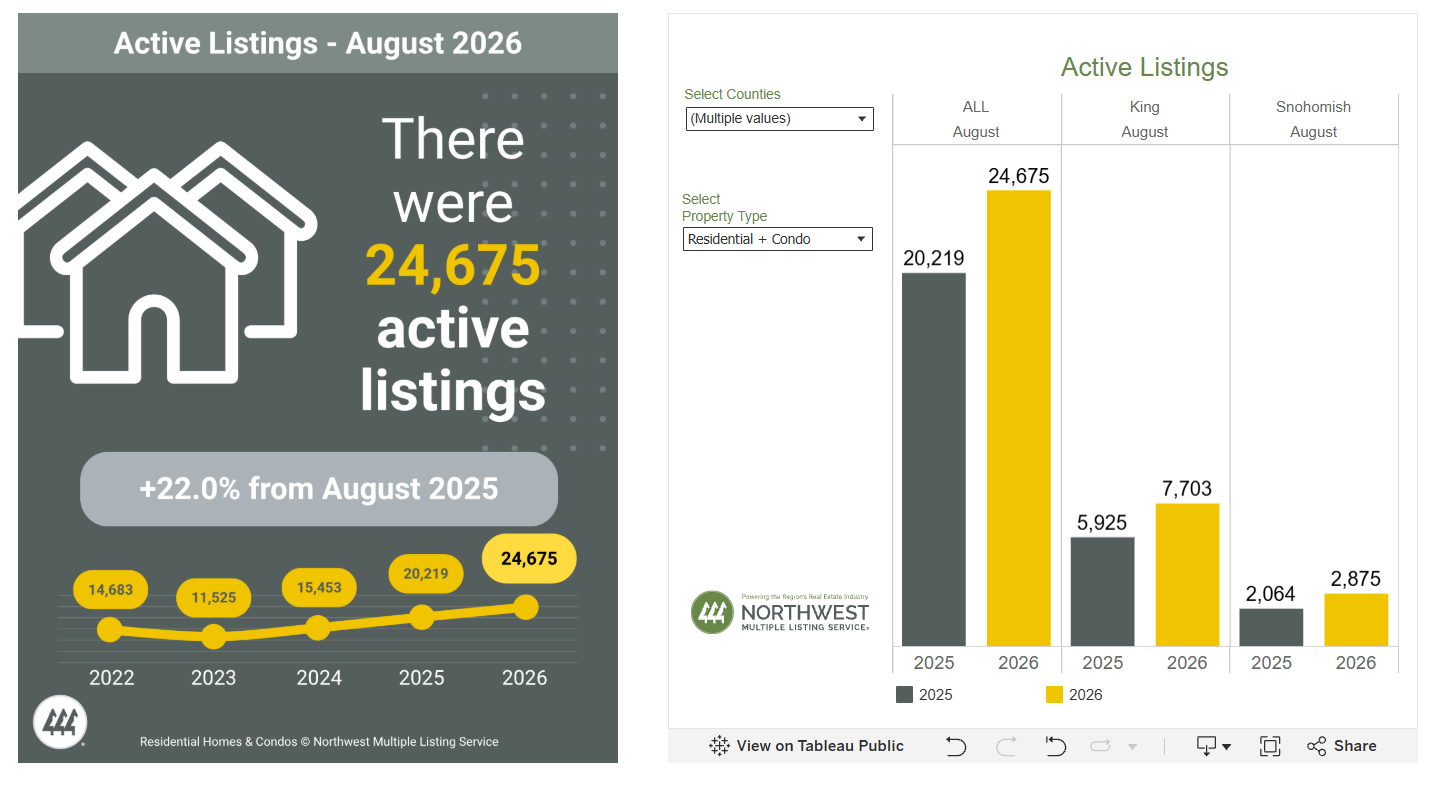
Across the NWMLS service area, active listings were up 22% from last August. Snohomish County saw one of the largest increases in the entire region, with inventory up 39.3% year over year. King County had 7,703 active listings in August, approximately 30% more than a year ago.
That changes the buying experience.
When there are only a handful of homes available, buyers may feel like they have to make a decision quickly because they don’t know when another option will come along.
Today, there may be three or four homes that could work instead of just one.
Buyers can compare. They can think. They can have an inspection, after an offer has been accepted. They can decide that they don’t like the busy street, the small backyard or the weird kitchen enough to overlook it.
That doesn’t necessarily make them unreasonable. It gives them choices.
Sellers Can Still Sell, But Buyers Don’t Have to Settle
This may be the hardest adjustment for sellers.
A few years ago, a home could have some quirks and buyers often had to decide whether they were willing to live with them. There simply weren’t many alternatives.
That is not necessarily the case today.
A home can be perfectly nice and still sit on the market because another home has a better floor plan, is more updated, has a bigger yard or is simply priced better.
We are also seeing fewer sales. Across the NWMLS service area, closed sales were down 7.6% compared with August of last year, while active inventory increased 22%.
That combination is important. There are more homes competing for fewer sales.
That doesn’t mean homes aren’t selling. It means sellers must compete for the buyers who are out there.
Price matters. Condition matters. Presentation matters. Marketing matters. And sometimes patience matters.
A Balanced Market Doesn’t Mean Every House Takes Months to Sell
This is another misconception I think is important.
If the market is more balanced, it doesn’t mean every house suddenly sits for 60 or 90 days.
Good homes can still sell quickly.
A home that is well positioned for its neighborhood, condition and price range can still attract immediate attention, and sometimes multiple offers.
At the same time, another house a few blocks away may sit.
That isn’t necessarily contradictory. It is actually part of what a more balanced market looks like.
Buyers are becoming more selective, and they are responding quickly when they see something they perceive as a good value.
It May Not Feel Very “Balanced” to Sellers
I recently wrote about the question I am hearing from sellers, and frankly asking myself with some listings: Why isn’t my house selling?
If your home has been on the market for 30, 60 or 90 days without an offer, hearing that we are in a “balanced” market probably doesn’t feel particularly balanced.
Especially if you remember when your neighbor put their house on the market a few years ago, received seven offers that weekend and sold well over asking.
But that wasn’t a balanced market. That was an extreme seller’s market.
What we are experiencing today can feel discouraging by comparison simply because our expectations were shaped by an unusual period in real estate.
Waiting several weeks for the right buyer isn’t necessarily an indication that something has gone terribly wrong.
Sometimes it is simply what selling a house looks like when buyers have choices.
And It Doesn’t Necessarily Feel Easy for Buyers Either
This isn’t suddenly a buyer’s paradise.
Yes, buyers have more negotiating power. Yes, they have more inventory to choose from. And yes, they often have more time to make a decision.
But affordability is still a very real issue.
The median sales price in August was $845,000 in King County and $724,500 in Snohomish County.
Having 15 homes to choose from instead of five doesn’t necessarily help if the monthly payment is still higher than you are comfortable with.
And the best homes, particularly those that are well priced, well maintained and in desirable locations, can still receive significant attention.
Buyers have more leverage than they did a few years ago, but that doesn’t mean they hold all the cards.
There Really Isn’t One “Market”
This is probably one of the most important things to understand.
We talk about “the real estate market” as though every home from Seattle to Everett is experiencing the same thing.
They aren’t.
King County is currently at 4.3 months of inventory while Snohomish County is at 3.64. Even within those counties, the experience can change dramatically depending on the city, neighborhood, price point and type of property.
A condo in North Seattle can be experiencing a very different market than a single-family home in Shoreline. A $700,000 home can behave differently than a $1.5 million home. One neighborhood may have very little available inventory while another has several similar homes competing against each other.
That is why broad market statistics are useful, but they are only the starting point.
The market that matters most is the market surrounding the specific home you are buying or selling.
Maybe “Normal” Is a Better Word
For years, buyers were told to hurry. Sellers were told to expect multiple offers. Inspections were waived. Decisions were made in hours instead of days.
That became our definition of a “normal” real estate market because it lasted long enough for us to get used to it.
It wasn’t normal.
A healthier market gives buyers enough choices that they don’t have to buy something simply because it is available. It gives them the opportunity to do their due diligence.
At the same time, sellers can still sell their homes and build equity, but they have to pay attention to their competition and respond to what buyers are telling them.
Neither side necessarily gets everything they want.
And maybe that is what balance actually looks like.
The August numbers aren’t telling us that we have suddenly entered a buyer’s market. They are telling us that the extreme seller’s market we became accustomed to has continued to fade.
For buyers, that means more choices, more time and more opportunities to negotiate.
For sellers, it means pricing and preparation matter again, and selling may require more patience.
And for both sides, it means understanding the specific market you are in has become much more important than simply asking whether it is a buyer’s market or a seller’s market.

